





Brundage Lab Launches at UW–Madison School of Veterinary Medicine
Dr. David Brundage University of Wisconsin–Madison
Resources
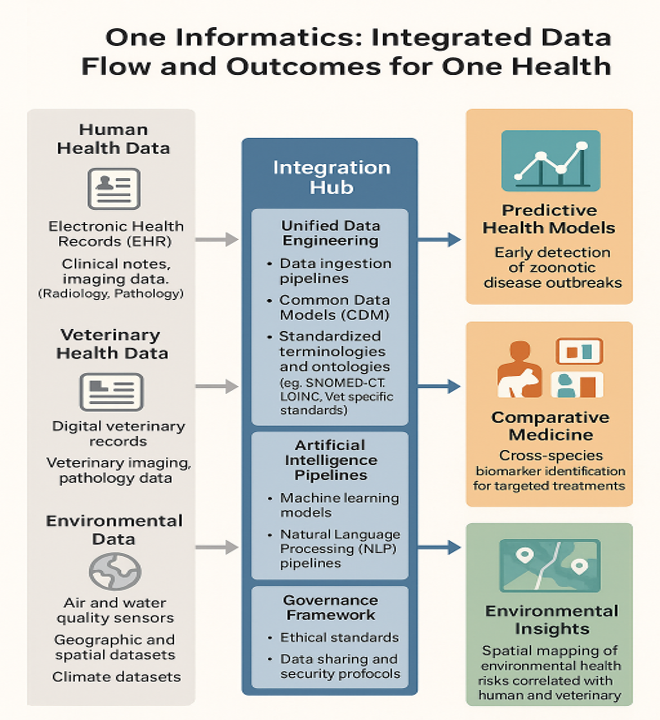
The Brundage Lab is an interdisciplinary research group at the University of Wisconsin–Madison School of Veterinary Medicine. As part of the Department of Surgery, our team focuses on developing safety-aligned, agentic, and multimodal artificial intelligence tools to support the diagnosis and prognosis of disease systems in both veterinary and human medicine. Our goal is to leverage a foundation of biomedical informatics and our experience in broad health information systems to integrate veterinary and human EHR data, advancing the One Health mission.
We believe that any successful implementation of a clinical AI system, no matter the patient’s species, requires careful collaboration and side-by-side development with clinicians. We adhere to the principle of “Augmented Intelligence Systems,” where deployed AI supports rather than replaces the clinician in the loop. While clinical decision support systems have historically relied on heuristic rule engines, the shift toward advanced, generative AI requires new safeguards. We are committed to developing systems that are not only intelligent but rigorously aligned with clinical safety standards.
So, how do clinicians interact with emerging artificial intelligence systems? What does “Agentic AI” mean in medicine when the AI cannot be held liable? The Brundage Lab explores the interaction of these intelligent systems with clinicians to understand the limitations of the augmented practitioner. We are also actively developing practical, applied AI curricula to train the next generation of veterinarians to utilize these tools effectively. Furthermore, we believe that clinical AI is not limited to specialized centers but should elevate ancillary care staff working in resource-limited settings.
The Brundage Lab believes in researching all aspects of AI in practice. Advancing AI isn’t just about better algorithms—it also requires an ecosystem built on data, standards, and continuous evaluation. Beyond model development, we must also explore how to access and deliver high-quality multimodal data, and how that data is curated and annotated with domain expertise. Can we identify new, scalable labeling strategies? How do we ensure that patient data is de-identified, private, and secure? How do we enrich and refine models through post-processing? Do we need new, robust, representative, and reproducible evaluation metrics? What about new benchmarks specifically for veterinary medicine and One Health? Finally, how do we integrate and deploy AI in real-world applications?
As we establish this new chapter at UW–Madison, the Brundage Lab is committed to building an open, collaborative, and forward-looking research program that bridges the boundaries between veterinary, human, and planetary health. By combining rigorous informatics, cutting-edge AI, and a One Health perspective, we aim not only to advance scientific discovery but also to create practical tools that improve clinical outcomes and expand access to care across diverse contexts. We look forward to working with students, clinicians, and collaborators worldwide to shape the future of intelligent health systems.